The Dirty and Vital Trinity River
Recent reporting from Robert Wilonsky and Lori Brown about the illegal trash dump at McCommas Bluff might give any historian a powerful sense of deja-vu. After all, it was only a little over a century ago that Texas state health officials published a report on the waterway full of scenes that are distressingly stomach-churning: detritus drifting downstream from Fort Worth and Dallas; dead fish; even bloated cows and mules who made the mistake of stopping for a drink. Reflecting on the river’s filth, the authors of the 1925 report likened it to “some mythological river of death.” Oak Cliff T-Bone Walker, singing four years later, put it plainer: “That dirty Trinity River sure has done me wrong.”
But as much as the Trinity’s pollution has long been a source of disgust, its filthiness has also played a role in the region’s development. As early as the late 1800s, Dallas residents refused to drink from the Trinity, forcing city leaders to search beyond the river’s mainstem for potable water. They went only a few miles away to the Elm Fork and then White Rock Lake, but by the 1920s were building dams about 30 miles away on the Elm Fork. At first there was sufficient water in the mainstem Trinity for the fast-growing city—then not quite among the nation’s forty most-populous—but the river’s pollution pushed Dallas to think regionally sooner than it might have otherwise.
The pollution created other challenges, too. Not long after the Army Corps of Engineers built a lock dam at McCommas Bluff in the early 1900s, Dallas residents realized that the river’s potential local navigability had come at a cost: it stank. Stagnant water backed up all the way to downtown, leading citizens to beg the Corps to let the river flow more freely again. But the “Trinity Pool” had its defenders, too—like the Dallas Waterworks and Sewerage Commissioner, who wanted to keep it filled since the fetid waters could be useful in fighting fires, and so would help keep insurance rates contained.
By 1973, boosters made the Trinity’s filth a central issue in their campaign to canalize it, flooding the region’s newspapers with flyers featuring floating trash. Their contention: only a canal could somehow clean the river. The reality: the parts of the canal project that were built at the start of the century only made the river dirtier.
Yet despite the Trinity’s long history of pollution, more Texans depend on its water than any other Texas river—not only in Dallas-Fort Worth, but in Houston and East Texas, too. And so I am often asked why, if the river is so important today, does it remain so neglected? The visible pollution certainly plays a role, keeping people away; so do the levees, which block our view. And then there is the history itself: as the most navigable river in Texas, the Trinity was once a central plantation region. The human stories of resilience and recovery, slavery and freedom, have been hidden in the bottomlands. While the Mississippi Delta might be the birthplace of the blues, a distinctive Texas style is rooted in our rivers and history.
Still, citizen leaders like Ben Sandifer help to sustain the attention to ongoing crimes like the McCommas dump, and their deep concern is rooted in the incredible natural beauty and human history that lies within the Trinity floodplain. As Ben Masters noted in his recent interview in these pages about the premiere of Texas Rivers, “The Trinity is often looked at as a dirty river, but it’s a wonderful, vibrant river ecosystem.” Which is probably why Charley Crockett’s 2015 song “Trinity River” seems so appropriate: “such a dirty little river, but that don’t bother me, dirty little river sure to wash me clean.”
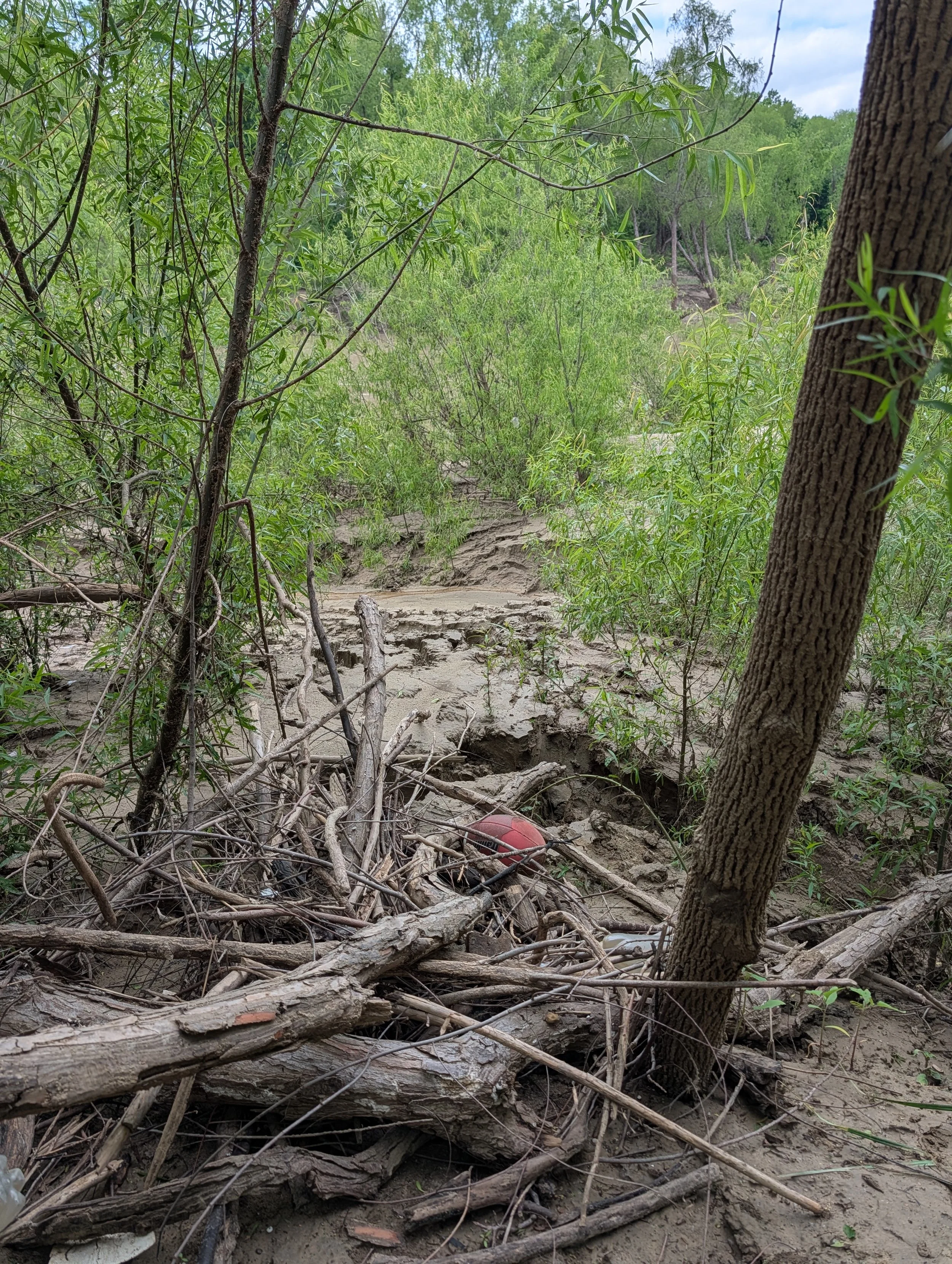
Trinity Trash, a Texas football included! This photo was taken by the author in April 2026.